
How the 2024 Ontario Building Code Redefines Occupant Load—and Why It Matters
The Difference One Clause Can Make
The Ontario Building Code (OBC) is a comprehensive document with over 800 pages filled with countless requirements that shape the safety, functionality, and usability of buildings. Given its extensive and detailed nature, could altering just one clause significantly impact the design process? Surprisingly, yes.
With the recent transition from the 2012 edition to the 2024 Ontario Building Code, effective January 1, 2025, several important changes have come into effect. Among these revisions, one seemingly minor modification regarding occupant load calculation warrants closer attention. Understanding this revision is critical, as it has substantial implications for architects, engineers, designers, and building owners alike.
Understanding Occupant Load
Occupant Load is defined by the OBC as “the number of persons for which a building or part of a building is designed.” Essentially, occupant load represents the maximum permitted number of individuals in a particular space.
Why is occupant load significant? Beyond the basic knowledge of how many people can occupy a space, occupant load directly influences numerous design elements, notably the number and layout of required washrooms and exit facilities. A seemingly small adjustment in occupant load can have far-reaching effects on the overall design, functionality, and even cost of a project.
The Difference One Clause Can Make
The Ontario Building Code (OBC) is a comprehensive document with over 800 pages filled with countless requirements that shape the safety, functionality, and usability of buildings. Given its extensive and detailed nature, could altering just one clause significantly impact the design process? Surprisingly, yes.
With the recent transition from the 2012 edition to the 2024 Ontario Building Code, effective January 1, 2025, several important changes have come into effect. Among these revisions, one seemingly minor modification regarding occupant load calculation warrants closer attention. Understanding this revision is critical, as it has substantial implications for architects, engineers, designers, and building owners alike.
Understanding Occupant Load
Occupant Load is defined by the OBC as “the number of persons for which a building or part of a building is designed.” Essentially, occupant load represents the maximum permitted number of individuals in a particular space.
Why is occupant load significant? Beyond the basic knowledge of how many people can occupy a space, occupant load directly influences numerous design elements, notably the number and layout of required washrooms and exit facilities. A seemingly small adjustment in occupant load can have far-reaching effects on the overall design, functionality, and even cost of a project.
Reviewing the Change: From 2012 to 2024
Prior to 2025, designers working with the 2012 OBC could calculate occupant load based on either:
- A design occupant load tailored to the intended specific use of the space, or
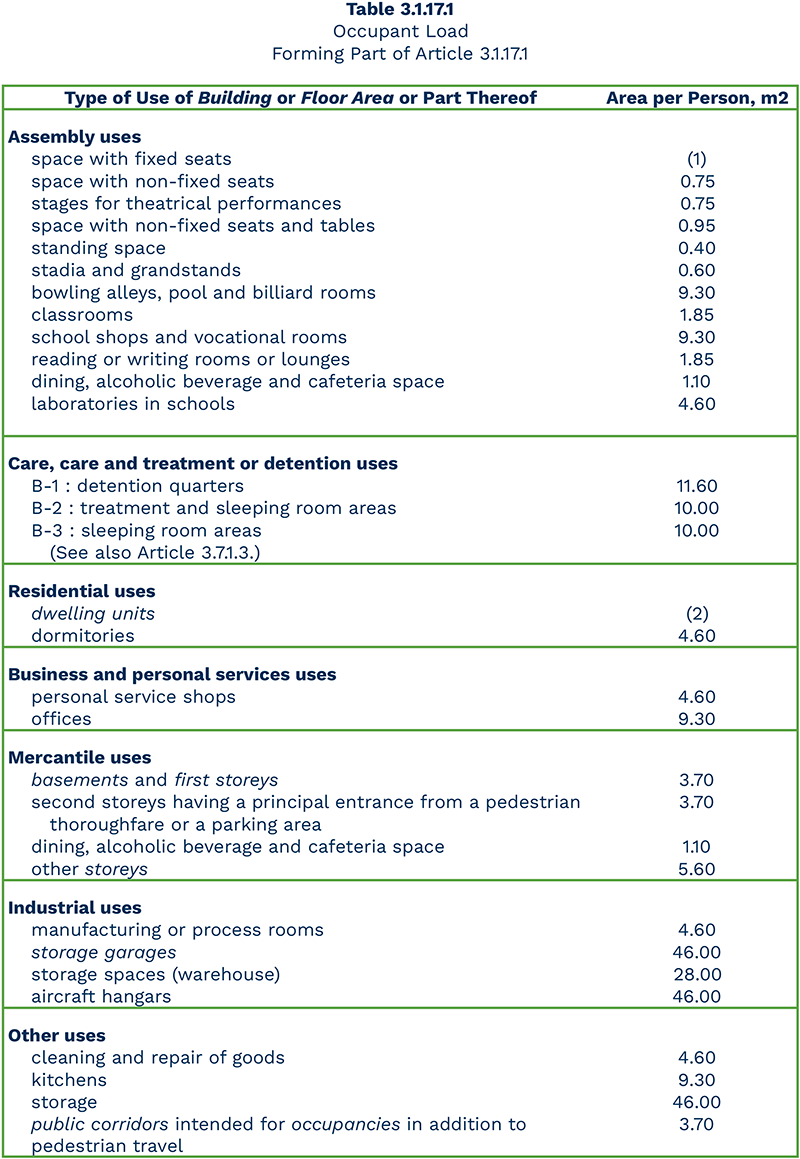
- Occupant load factors provided by OBC Table 3.1.17.1., which prescribes occupant densities (m2/person) based on typical use categories.
This flexibility allowed for practical, tailored designs that could better reflect the actual use of a space, subject to approval by the Authority Having Jurisdiction (AHJ).
Consider an example: A community gymnasium of 200 m² could have a calculated occupant load of up to 500 people (using the prescribed factor of 0.40 m² per person). However, recognizing that such tight occupancy is rarely realistic in a community gym setting, designers could reasonably propose a lower occupant load based on actual intended use.
The Crucial Revision in the 2024 OBC
In the newly effective 2024 OBC, Clause 3.1.17.1.(1)(c) now reads as follows:
“(1) The occupant load of a floor area or part of a floor area shall be based on
(c) the number of persons for which the area is designed, but not less than that determined from Table 3.1.17.1., unless it can be shown that the area will be occupied by fewer persons.”
At first glance, this change might appear minor. However, the implications are significant.
While designers can still propose occupant load values lower than the table suggests, they now face a critical additional element: providing evidence or methods demonstrating actual occupant load control. This means the building owner must actively and effectively manage occupant load, which is possible through physical or operational measures (e.g., access control systems, registered occupants, or management procedures).
This shift substantially increases the burden of proof for designers and building owners alike, making the table-based occupant load a default minimum rather than how it was previously used as a recommended baseline.
Real-World Implications for Designers and Building Owners
This subtle wording change has major impacts, particularly in buildings classified as assembly occupancies – such as multipurpose rooms, gymnasiums, conference spaces, and auditoriums – where prescribed occupant loads can significantly exceed practical or intended capacities.
As the occupant load increases, building features reliant upon these numbers – such as washroom facilities and exit routes – must proportionally expand. For instance, an increase in occupant load directly translates to a requirement for more washrooms, significantly impacting building layouts, floor area usage, and overall design complexity. Additionally, increased occupant loads can necessitate additional or larger exits, further impacting spatial planning, structural design, and ultimately the construction budget.
Planning for the Future: Strategies and Recommendations
Designers and building owners must carefully strategize early in project planning to navigate this clause effectively:
- Evaluate early: Identify realistic occupant loads based on actual intended uses. Early negotiation with AHJs regarding proposed occupant loads is advisable.
- Develop control measures: Where occupant load reduction below the prescribed table values is necessary, plan reliable, enforceable occupant load controls early, ensuring these are practical and sustainable.
- Consider space implications early: Account for increased washroom requirements and enhanced egress capacities upfront to avoid costly redesigns later.
Conclusion: The Big Impact of Small Changes
The 2024 Ontario Building Code revision clearly illustrates how a seemingly minor adjustment can ripple through building design and planning processes. Designers and building owners should be aware of this occupant load determination change and its potential implications. Being proactive in addressing occupant load criteria, engaging effectively with AHJs, and strategically planning occupant control measures can mitigate potential challenges, streamline approval processes, and ultimately contribute to safer and more functional buildings.
Understanding Clause 3.1.17.1.(1)(c) and its implications helps promote compliance, efficiency, and optimal safety in your next project.