
How LOS Analysis Improves Building Design and Occupant Movement
Pedestrian Level of Service (LOS) is one of the most widely recognized methods for evaluating pedestrian movement and egress performance within buildings and public spaces. Developed by John J. Fruin, Pedestrian Level of Service provides a measurable framework for assessing how pedestrian density, available space, walking speed, and freedom of movement influence occupant comfort, circulation efficiency, and safety. Today, LOS analysis is routinely used by engineers, planners, and designers to evaluate crowd movement, identify congestion points, and support performance-based design decisions.
The principle behind LOS is simple: as the number of people occupying a space increases, the amount of personal space available to each individual decreases. This reduction in available space has a direct impact on walking speed, route choice, maneuverability, and overall pedestrian behaviour.
While Levels of Service are often discussed in the context of transportation facilities such as transit stations, airports, and sidewalks, they are also valuable in the design and assessment of other structures. The concept provides a common language for comparing pedestrian conditions and understanding how design decisions influence occupant movement.
Understanding Levels of Service
Fruin defined six Levels of Service, designated LOS A through LOS F, mainly in the context of walkways, queuing and stairways, representing progressively deteriorating pedestrian conditions. The classification is based primarily on the amount of available space per pedestrian and the resulting effect on movement.
At LOS A, pedestrians experience virtually unrestricted movement. Individuals can select their walking speed, adjust direction freely, and avoid conflicts with others with little effort. Interaction with surrounding pedestrians is minimal, and comfort levels are high.
LOS B represents a slight increase in density. While some awareness of nearby pedestrians becomes necessary, movement remains largely unrestricted. Walking speeds are close to normal, and overtaking or changing direction can still occur with minimal inconvenience.
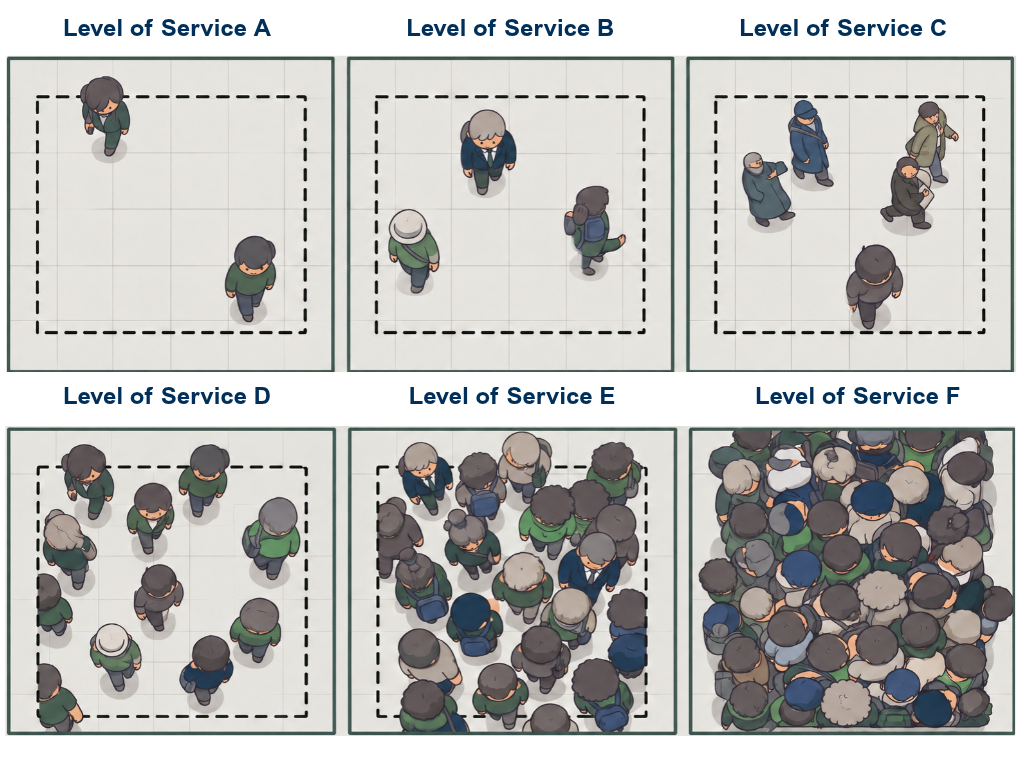
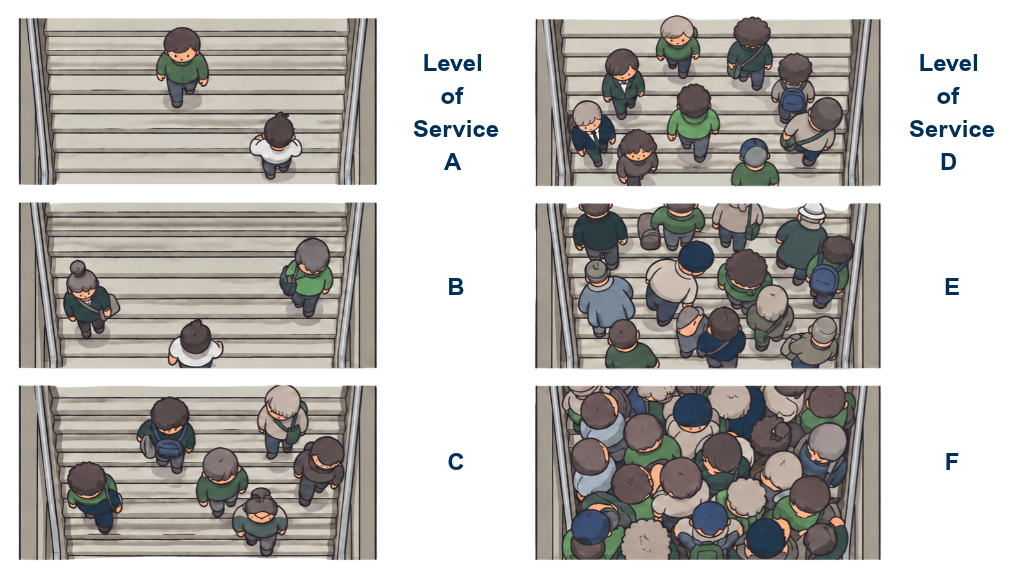
At LOS C, pedestrian interactions become more frequent. Individuals begin adjusting their paths to avoid collisions, and freedom to select preferred walking speeds is moderately constrained. Nonetheless, circulation remains relatively comfortable and efficient.
LOS D marks the transition to crowded conditions. Walking speeds begin to decrease noticeably as pedestrian density increases. Maneuverability becomes limited, overtaking slower individuals becomes difficult, and conflicts between occupants become more common. While movement remains possible, comfort is significantly reduced.
At LOS E, pedestrian flow approaches capacity. Movement is heavily constrained, with individuals having little freedom to alter speed or direction. Small disruptions may cause localized congestion, and walking speeds are primarily dictated by the surrounding crowd. These conditions can often be observed near heavily utilized exits, ticket barriers, or bottlenecks.
Finally, LOS F represents breakdown conditions where pedestrian demand exceeds available capacity. Severe crowding occurs, movement becomes intermittent or stalled, and queues naturally form. Under these circumstances, individuals lose the ability to choose their own pace and movement is governed by crowd dynamics.
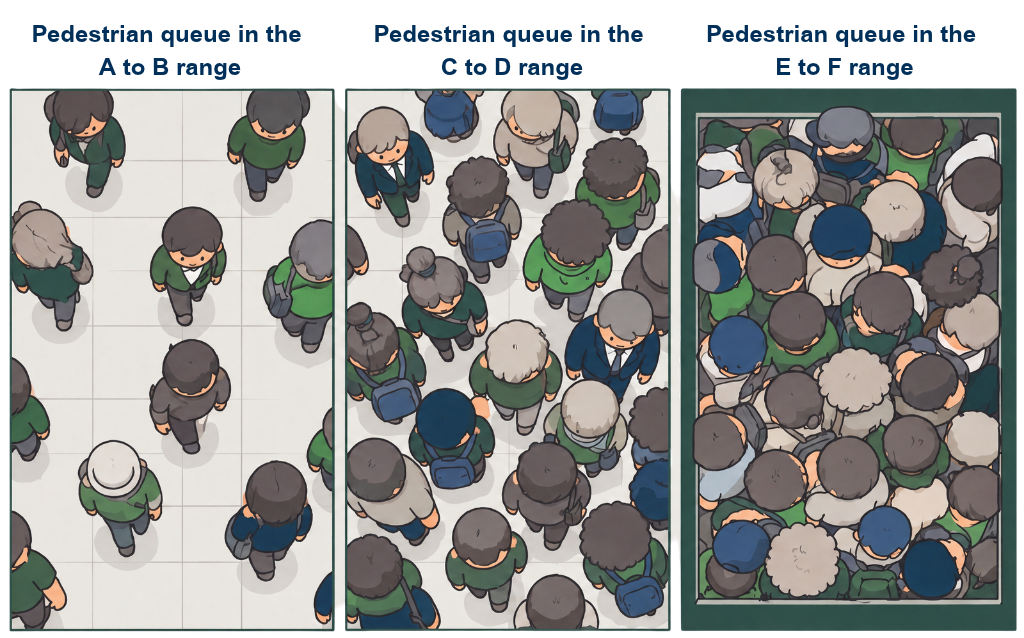
Each LOS category is defined by quantifiable thresholds, including pedestrian density, walking speed, and flow rate, which collectively provide an objective measure of circulation performance and the resulting quality, comfort, and efficiency of pedestrian movement.
LOS as a Design Tool
The practical value of Levels of Service lies in their ability to evaluate the quality of pedestrian circulation rather than simply verifying minimum code compliance.
Traditional prescriptive codes establish minimum requirements such as exit widths, travel distances, and occupant loads. While these requirements provide a baseline level of safety, they do not necessarily indicate how comfortable or efficient pedestrian movement will be under normal or emergency conditions.
LOS provides an additional performance measure that enables designers to assess whether spaces function as intended. For example, two corridor designs may both satisfy code requirements, yet one may operate at LOS B while the other operates at LOS E during peak occupancy. Although both designs technically comply with code, the user experience and movement efficiency will differ substantially.
By evaluating LOS during the design process, engineers can identify areas where congestion is likely to occur and optimize layouts accordingly.
Because LOS directly relates to pedestrian comfort and mobility, it allows designers to move beyond a simple pass/fail assessment and consider how occupants will actually use the space.
Use in Comparative Studies During Renovation Projects
A valuable application of LOS lies in comparative assessments of existing and proposed configurations during renovation, expansion, or change-of-use projects.
In many projects, the key question is not always whether a structure can be made fully compliant with every current prescriptive requirement, but whether the proposed design results in equivalent or improved performance compared to existing conditions. LOS provides a quantitative basis for making these comparisons and therefore LOS functions as both a diagnostic and comparative tool.
For example, consider a renovation that introduces additional office space and increases the occupant load on a floor. A purely prescriptive review may identify that corridor widths or exit capacities remain technically compliant. However, LOS analysis may reveal that pedestrian conditions during peak periods deteriorate from LOS C to LOS E. Although the building still complies with minimum code requirements, occupant movement becomes noticeably less efficient.
Conversely, the renovation may involve reconfiguring a floor plan and slightly reducing the corridor width. At first glance, the change may appear detrimental. However, an analysis could demonstrate that occupant loads are simultaneously reduced, resulting in essentially unchanged pedestrian densities and maintaining the same operational LOS. In this case, the renovation may have little practical effect on movement performance.
This comparative approach is particularly useful when evaluating alternative solutions as part of performance-based design. Rather than focusing solely on geometric dimensions, engineers can assess the actual impact of proposed changes on occupant movement and identify where design improvements may most effectively influence overall egress performance of a structure.
The resulting analysis provides a clear and defensible demonstration of whether pedestrian conditions improve, remain unchanged, or deteriorate following the proposed modifications.
Conclusion
Fruin’s Levels of Service remain one of the most practical and widely accepted methods for evaluating pedestrian movement. By linking pedestrian density to walking speed, maneuverability, and comfort, LOS provides a meaningful measure of circulation quality within a building.
Beyond its traditional use in transportation planning, LOS evaluation becomes valuable in other design and renovation projects because it offers an objective means of comparing existing and proposed conditions. Whether assessing a new design, evaluating the impact of a renovation, or supporting a performance-based design, LOS analysis allows engineers to establish how occupants will actually move through a space and whether proposed changes improve or degrade overall pedestrian and egress performance. In this manner, Levels of Service provide a bridge between space geometry, human behaviour, and people movement efficiency.