
Engineering Safe Evacuation in Large Assembly Spaces
Smoke-controlled egress facilities are fundamental to ensuring life safety in large indoor assembly buildings such as arenas, stadiums, and multi-use event centres. Smoke-controlled egress design focuses on maintaining tenable conditions for occupants during an emergency, particularly when evacuation must occur across large, interconnected spaces. In modern arenas, where occupant loads are high and spatial configurations are complex, smoke control systems designed using advanced modelling have become key to achieving safe and practical evacuation egress.
The Challenge
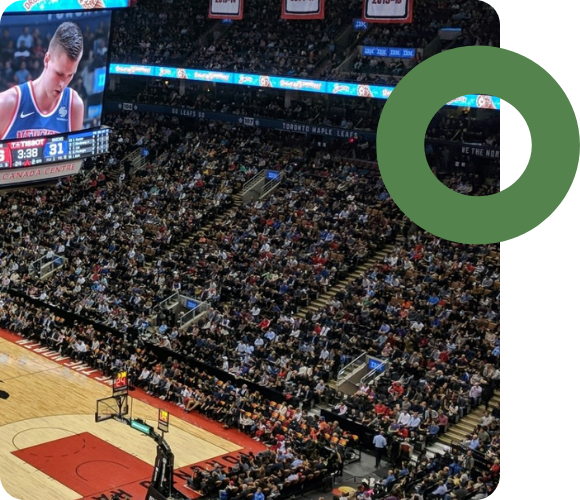
Designing for life safety in arenas presents different challenges than in other occupancies. These facilities often host tens of thousands of occupants within a single volume, combining seating bowls, concourses, and event floors into one interconnected space. In the event of a fire, smoke can quickly migrate between these spaces, affecting visibility and air quality at a scale not typically encountered in conventional buildings that feature more fire compartmentation. High occupant loads combined with limited exit capacity and extended travel distances create challenges for the design of egress systems, especially when multiple event configurations, from sporting events to concerts, must be accommodated.
Traditional prescriptive codes, including the Ontario Building Code (OBC) and National Building Code (NBC), provide baseline requirements for assembly occupancies. However, compliance with these provisions can be challenging for large indoor arenas. Limitations on travel distance, restrictions on dead-end aisles, and large widths for aisles and exit facilities can become impractical in real-world arena layouts. For example, standard travel distance limits of 45 metres and strict dead-end aisle limits can conflict with the geometry of large seating bowls, functionally limiting their size. Large exit capacity factors lead to very large exit widths, which are difficult to provide for levels above the ground level.
To address these constraints, the NBC permits the use of NFPA 101, “Life Safety Code” as an alternative compliance pathway for particular requirements. It is also possible to apply NFPA 101 in Ontario, however, doing so would require the approval of an Alternative Solution. Under NFPA 101, designers can apply provisions tailored specifically for smoke-protected assembly seating, enabling extended travel distances, up to 122 metres within seating areas and 61 m in concourses, and less restrictive exit design. However, this flexibility comes with the requirement for a comprehensive life safety evaluation and the implementation of engineered smoke control systems to maintain safe conditions during evacuation.
Engineering Smoke-Controlled Systems
At the core of smoke-controlled egress design is the requirement to maintain tenable conditions as occupants exit the building. This is achieved through engineered smoke control systems designed in accordance with NFPA 92. These systems manage smoke through a combination of mechanical exhaust, controlled makeup air, and airflow strategies that limit smoke spread and maintain visibility and relatively low temperatures in occupied zones. The critical objective is to keep the smoke layer from descending to head level, reducing occupants’ exposure to hazardous conditions.
The concept of tenability is central to this approach. During evacuation, occupants must be able to see exit paths, breathe safely, and tolerate ambient temperatures long enough to reach an exit. Industry benchmarks define acceptable conditions based on temperature and exposure duration, visibility in metres, and carbon monoxide concentrations. These criteria guide the design and validation of smoke control systems, ensuring they provide real, measurable life safety benefits.
To achieve these outcomes, engineers must consider a range of fire scenarios that reflect the credible fire risks within an arena. These include fires originating on the event floor, in concourses open to the seating bowl, and in enclosed concourse areas. Each scenario produces different smoke movement patterns and challenges, requiring tailored system design. For instance, a fire on the event floor may require large-volume exhaust from the bowl, while a concourse fire may demand localized smoke containment combined with exhaust to prevent migration into seating areas.
Because of the complexity of the geometry within arenas, computational modelling has become an important tool in the design of smoke control systems. Software such as Fire Dynamics Simulator (FDS) allows engineers to simulate smoke movement over time, accounting for factors such as geometry, ventilation, and heat release rates. Unlike simplified algebraic calculations, these models provide detailed insights into how smoke is expected to behave within a space, enabling designers to verify that tenability criteria are maintained throughout the evacuation period. By testing worst-case scenarios and conducting sensitivity analyses, engineers can refine system performance and ensure functionality under a variety of conditions.
Integration, Testing, and Reliability
Effective smoke-controlled egress design depends not only on engineering calculations but also on the integration of architectural, mechanical, and electrical systems. Architectural design must define and separate smoke-protected and non-smoke-protected zones, ensuring continuity of fire and smoke separations while accommodating operational features such as doors and stair openings. Mechanical systems must be carefully designed to deliver the required exhaust and supply airflows, with attention to fan selection, distribution, and response time. At the same time, electrical systems must provide reliable control and power, including detection and automatic activation, manual controls, integration with fire alarm systems, and emergency power backup.
This level of integration introduces complexity, particularly during commissioning and operation. Comprehensive testing is essential to confirm that all components function together as intended. This includes verifying airflow rates, pressure differentials, control sequences, and system response times. Door opening forces must also be evaluated to ensure that pressure differentials created by the smoke control system do not prevent occupants from using egress and exit doors. Demonstration tests can provide additional validation by illustrating how systems perform and helping identify potential gaps in design or installation. However, it should be noted that in demonstration tests it is difficult to accurately replicate the buoyancy of smoke from a real fire, which means that the smoke used for a demonstration test would behave differently than in a real fire scenario.
Experience has shown that even well-designed systems can encounter challenges during implementation. Potential issues include discrepancies between design models and as-built conditions, incorrect programming of fire alarm or building automation systems, incomplete fire separations, and inadequate smoke detection coverage. These challenges highlight the importance of coordination, quality control, and documentation throughout the project.
After construction, long-term effectiveness and reliability depends on proper training and maintenance. Building operators must implement comprehensive fire safety plans, conduct training and evacuation drills, and ensure that all systems are clearly documented and understood by building staff. Annual testing of smoke control systems is critical to maintaining performance and ensuring that system components function as intended. Without proper training and maintenance, smoke control system components may degrade over time or systems may be used incorrectly, compromising life safety.
Conclusion: The Future of Arena Life Safety
Smoke-controlled egress design allows engineers to deliver egress solutions that are both practical and safe and tailored to the unique challenges of arena design. The integration of NFPA standards, advanced modelling tools, and coordinated system design enables the creation of spaces where tenable conditions are maintained, giving occupants more time to evacuate safely. Engineered smoke control systems have become key to facilitating modern arena designs and will continue to play a key role as arenas evolve in size and functionality.